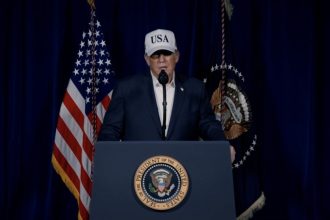
Iran’s state media has confirmed that Supreme Leader Ali Khamenei has been killed, after attacks across Iran by Israel and the US, which began on Saturday morning local time.
The state media announcement of Ayatollah Khamenei’s death came after US President Donald Trump said he was dead and Israeli Prime Minister Benjamin Netanyahu announced that Khamenei’s Tehran compound had been destroyed in “a powerful, surprise strike”.
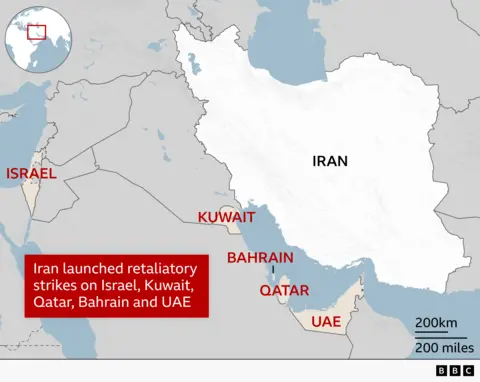
Iran responded to the attack, which came two days after US-Iranian talks on Tehran’s nuclear programme ended without a deal, by launching missiles and drones towards Israel and four Gulf Arab countries which host US military bases: Bahrain, Kuwait, Qatar and the UAE.
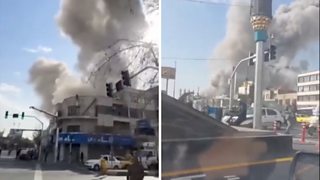
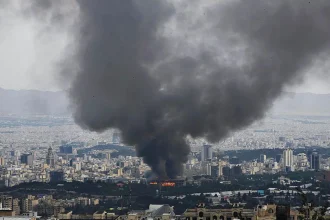
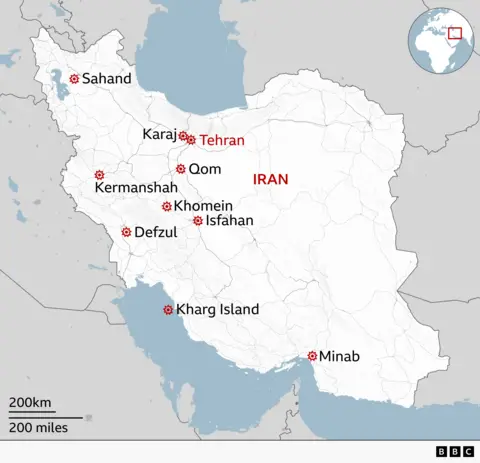
Shortly after 09:30 local time (06:00 GMT) on Saturday, Iranian media reported explosions in the capital, Tehran. Pictures showed smoke over the city’s Jomhouri Square and Hassan Abad Square.
Explosions were also reportedly heard in several other cities across the country, including Karaj, near Tehran, Isfahan and Qom in the centre of the country, and Kermanshah in the west.
A spokesman for the Iranian Red Crescent told local media 24 of Iran’s 31 provinces had been hit in US and Israeli strikes.
Videos circulating on social media showed people running in panic near sites of explosions. The sound of screams and crying could be heard in the background.
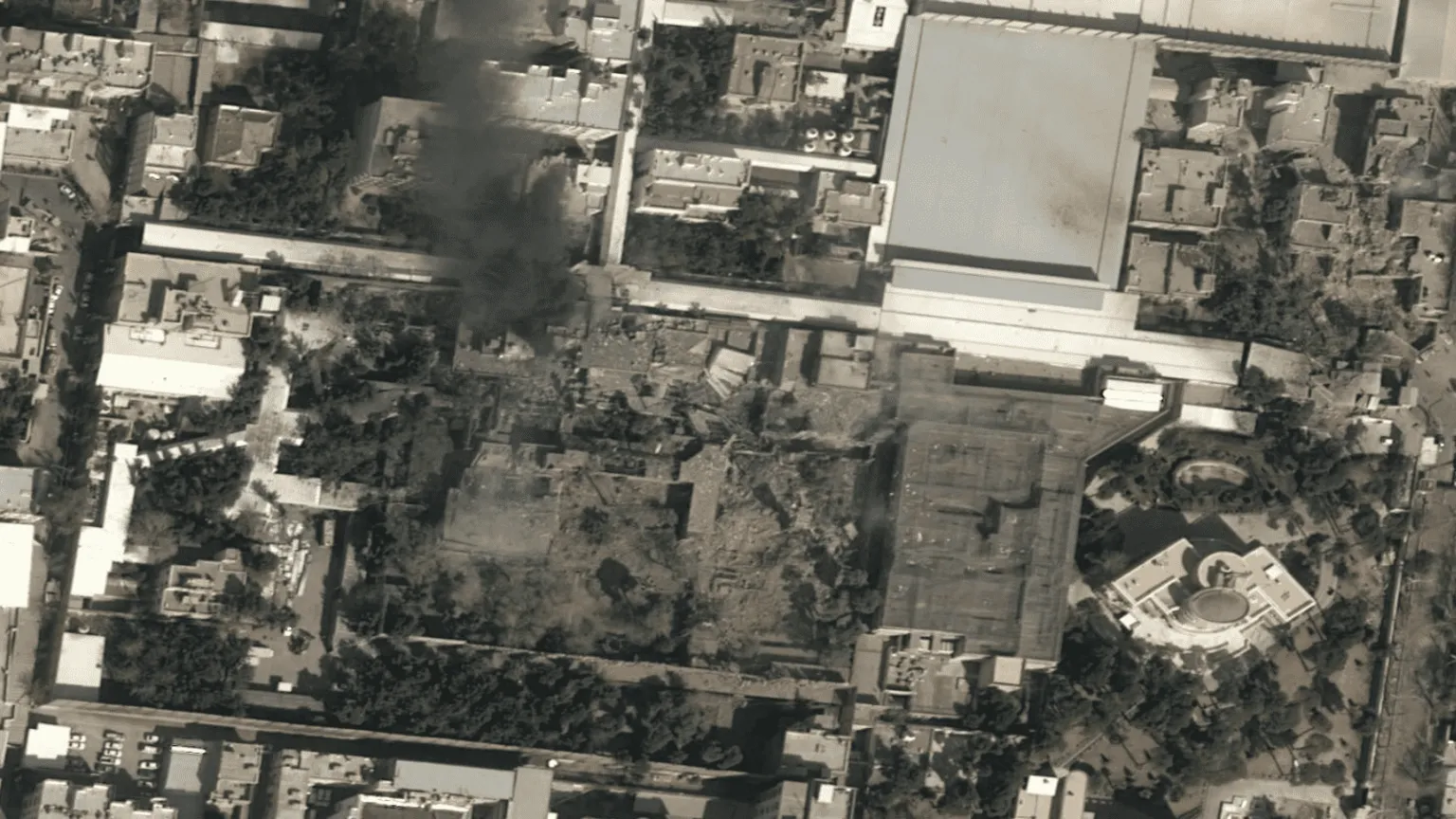
Footage from Tehran verified by the BBC showed explosions within 1km (0.6 miles) of Leadership House, Khamenei’s compound. It was not immediately clear whether he was there at the time of the strikes.
Satellite imagery obtained by the BBC also showed signs of significant damage in the compound, including blackened buildings, debris and a column of smoke.
On Saturday evening, Netanyahu said in a televised address that “we destroyed the compound of the tyrant Khamenei in the heart of Tehran”. “There are many signs that the tyrant himself is no more,” he added.
Trump then wrote on Truth Social: “Khamenei, one of the most evil people in History, is dead.”
“He was unable to avoid our Intelligence and Highly Sophisticated Tracking Systems and, working closely with Israel, there was not a thing he, or the other leaders that have been killed along with him, could do.”
It was confirmed statement from Iran’s Supreme National Security Council – read out by several state broadcast channels on Sunday morning local time – that Khamenei had been killed in his office.
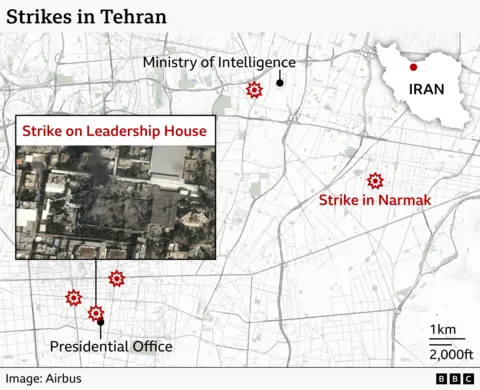
The office of President Masoud Pezeshkian in the capital was also reportedly targeted in the first wave of strikes. Iranian state TV said President Masoud Pezeshkian was “safe” and he later put out a statement.
Despite a near-total internet blackout that monitors detected late on Saturday morning, several further waves of strikes and explosions were reported throughout the day.
Iran’s Civil Aviation Organisation has said the country’s airspace is closed until further notice.
What have the US and Israel said?
On Saturday morning, Israeli Defence Minister Israel Katz said his country had “launched a preemptive strike against Iran to remove threats” and warned Israelis to prepare for retaliatory missile and drone attacks.
Just over an hour later, Trump confirmed US involvement in the strikes.
“We’re going to destroy their missiles and raze their missile industry to the ground. It will be totally again obliterated,” he said in a video posted on Truth Social.
“And we will ensure that Iran does not obtain a nuclear weapon.”
It came after weeks of threats from Trump that he would order military action if Iran did not agree a new deal over its nuclear programme.
Iran has said repeatedly its nuclear activities are entirely peaceful.
Trump also said members of Iran’s armed forces must lay down their weapons to get “complete immunity”, or “face certain death”.
And he urged Iranian people to prepare to overthrow the clerical establishment.
“When we are finished, take over your government. It will be yours to take. This will be probably your only chance for generations.”
Israeli Prime Minister Benjamin Netanyahu said his country and the US had “operation to remove the existential threat posed by the terrorist regime in Iran”.
The US military’s Central Command later said the allies wanted to “dismantle the Iranian regime’s security apparatus, prioritising locations that posed an imminent threat”. They reportedly included Islamic Revolution Guard Corps (IRGC) command-and-control facilities, air defence capabilities, missile and drone launch sites, and military airfields.
The Israel Defense Forces (IDF) said about 200 fighter jets had taken part in an “extensive attack against the missile array and the defence systems” in western and central Iran.
The jets simultaneously dropped hundreds of munitions on about 500 targets, it added.
The IDF named seven senior Iranian defence officials who it said had been killed, including Ali Shamkhani, secretary of Iran’s Defence Council and a trusted adviser to Khamenei, as well as IRGC commander Maj Gen Mohammad Pakpour and Defence Minister Brig Gen Aziz Nasirzadeh.
An intelligence source and a military source told the BBC’s US partner CBS that around 40 Iranian officials were killed in the strikes.
How has Iran responded?
Iran’s Foreign Minister Abbas Araghchi accused Israel and the US of launching a war that was “wholly unprovoked, illegal, and illegitimate”.
“Our powerful armed forces are prepared for this day and will teach the aggressors the lesson they deserve,” he wrote on X.
The Iranian defence ministry also vowed to deliver a “crushing and regret-inducing” response to what it called the “savage attack” by Israel and the US.
The semi-official Tasnim news agency cited the IRGC as saying its forces had responded to the strikes by hitting multiple sites in Israel as well as five major US military facilities in the region – Al Udeid airbase in Qatar, Al Dhafra airbase in the United Arab Emirates, the US Fifth Fleet headquarters in Bahrain, Ali Al Salem airbase in Kuwait, and Muwaffaq Salti airbase in Jordan.
The IRGC also said a US combat support vessel had come under “severe blows” from missiles, and that a US FP-132 radar system in Qatar had been “completely destroyed”.
The EU naval mission in the region, EUNAVFOR ASPIDES, meanwhile said that the IRGC had sent radio messages to vessels warning that “no ship is allowed to pass the Strait of Hormuz” in the Gulf, through which about 20% of global oil and gas shipments pass.
Centcom said that its forces had “successfully defended against hundreds of Iranian missile and drone attacks”.
It added that no US casualties or combat-related injuries had been reported and that damage to US installations in the region was “minimal and has not impacted operations”.
In Israel, local media reported that Iran launched about 150 ballistic missiles towards Israel, mostly in small salvos, as well as dozens of attack drones.
Air defence systems intercepted a number of the missiles, while others struck open areas, they added.
More than 200 people have been killed across Iran and more than 700 injured, according to the Red Crescent on Saturday.
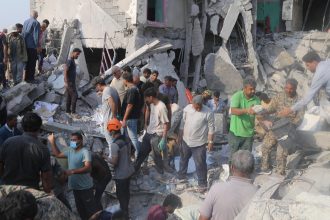
The first-aid organisation said that 24 of Iran’s 31 provinces had been hit. At least 108 people have died in an explosion at a school in southern Iran, according to a local prosecutor.
One person died and at least 20 were wounded when an Iranian missile hit several buildings in central Tel Aviv, reports the Israeli newspaper Haaretz.
In counterattacks, Iran also fired drones and missiles at Bahrain, Kuwait and Qatar the UAE, all of which have a US military presence.
One person was killed in Abu Dhabi, UAE state media said.
Trump said “the lives of courageous American heroes may be lost”, although the US military said it had received no reports of combat casualties so far.
He warned bombing would continue throughout the week, so the death toll may rise.
How might Khamenei’s successor be chosen?
In Iran, the Supreme Leader is not elected by direct vote but by a body of 88 senior clerics known as the Assembly of Experts.
They are elected by direct vote every eight years.
Under the Iranian Constitution, these clerics must select the new Supreme Leader as soon as possible, but this may prove difficult for safety reasons while the country is under attack.
The council of the president, the head of judiciary and a cleric member of the powerful Guardian Council will assume the leader’s responsibilities in the interim, Iranian state media has reported.
Is it safe to travel to the region?
Major airlines have diverted or cancelled hundreds of flights to the Middle East, citing safety concerns in the region.
Of about 4,218 flights scheduled to land in the region on Saturday, 966 were cancelled, according to data by aviation analytics company Cirium.
It said that 716 flights out of 4,329 Sunday’s scheduled flights have already been cancelled.
Wizz Air has suspended flights until 7 March in Israel, Dubai and Abu Dhabi in the UAE, Amman in Jordan, and in Saudi Arabia until Tuesday.
British Airways has cancelled flights to Tel Aviv and Bahrain until Wednesday.
“If you are due to fly between London Heathrow and Abu Dhabi, Amman, Bahrain, Doha, Dubai or Tel Aviv you can change your flight free of charge up to and including 6 March,” the company said.
“Customers travelling up to and including 4 March may also request a full refund.”
In a statement, Swiss International Air Lines said: “Swiss and the Lufthansa Group airlines will suspend flights to Tel Aviv, Beirut [in Lebanon], Amman, Erbil [in Iraq], and Tehran until 7 March.”
Kuwait’s aviation authority said it was halting all flights to Iran until further notice, according to state media.
Emirates has temporarily suspended its operations to and from Dubai. Lufthansa, Air India, Virgin Atlantic and Turkish Airlines have also announced cancellations.
Some countries in the region – including Iraq and Jordan – have also closed their airspace. The UAE said it has “partially and temporarily” closed its airspace as a precaution, state media reported.