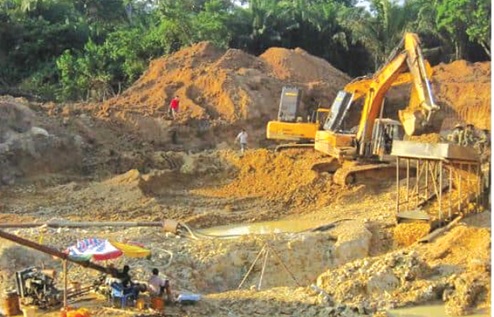
Ghana’s battle against illegal mining, widely known as galamsey, is often framed in terms of defeat. Polluted rivers, degraded forests, and repeated crackdowns create the impression of a country struggling to control a problem that refuses to go away.
But that framing, while emotionally powerful, misses something more important: Ghana is not simply losing this fight, it is being tested by it.
Galamsey is not a new crisis. It has evolved over decades, adapting to changing political climates, enforcement strategies, and economic conditions.
Each government that comes into power declares a renewed commitment to ending it. Task forces are formed, arrests are made, and operations are announced with urgency. Yet the persistence of illegal mining reveals a deeper reality.
This is not a problem that yields easily to short-term action. At its core, galamsey sits at the intersection of survival and destruction. For some communities, it is a source of income in the absence of viable alternatives.
For others, it is a network tied to influence, patronage, and political protection. And for the environment, it is a slow but devastating erosion of water bodies, arable land, and biodiversity.
These overlapping realities make the fight far more complex than a simple enforcement exercise.
This is where Ghana’s “test” becomes clear. It is not just a test of law enforcement capacity, but of consistency. It is a test of whether policies survive beyond political transitions. It is a test of whether institutions can act independently when pressure builds.
Most importantly, it is a test of whether national interest can be protected even when it conflicts with short-term economic or political convenience.
One of the biggest challenges in the galamsey fight has been continuity. There are moments of intensity, military deployments, bans, and high-profile crackdowns, followed by periods where enforcement weakens or attention shifts elsewhere.
Illegal mining thrives in these gaps. It adapts quickly, relocating deeper into forests or resuming operations when pressure reduces. This cycle has made the problem appear endless.
Yet it would be unfair to say nothing has been achieved. There have been arrests, disruptions of illegal operations, and growing public awareness about the environmental cost of galamsey.
Civil society voices, media pressure, and community activism have also strengthened over time. The issue is not the absence of action; it is the sustainability of that action.
If Ghana is to truly move beyond this cycle, the conversation must shift. Enforcement alone cannot carry the burden. There must be stronger investment in alternative livelihoods for mining communities, stricter protection of public officials and institutions from interference, and a consistent national policy that does not bend with political winds.
The galamsey fight is not a single war to be won in a single moment. It is a long test of discipline, governance, and national unity. And like all serious tests, the outcome will not be determined by how loudly the battle is announced, but by how consistently it is fought when public attention fades.
Ghana is not losing this war. It is being tested by it, and the final result will depend on whether the country chooses persistence over cycles, and action over rhetoric, long enough to turn commitment into real change.