


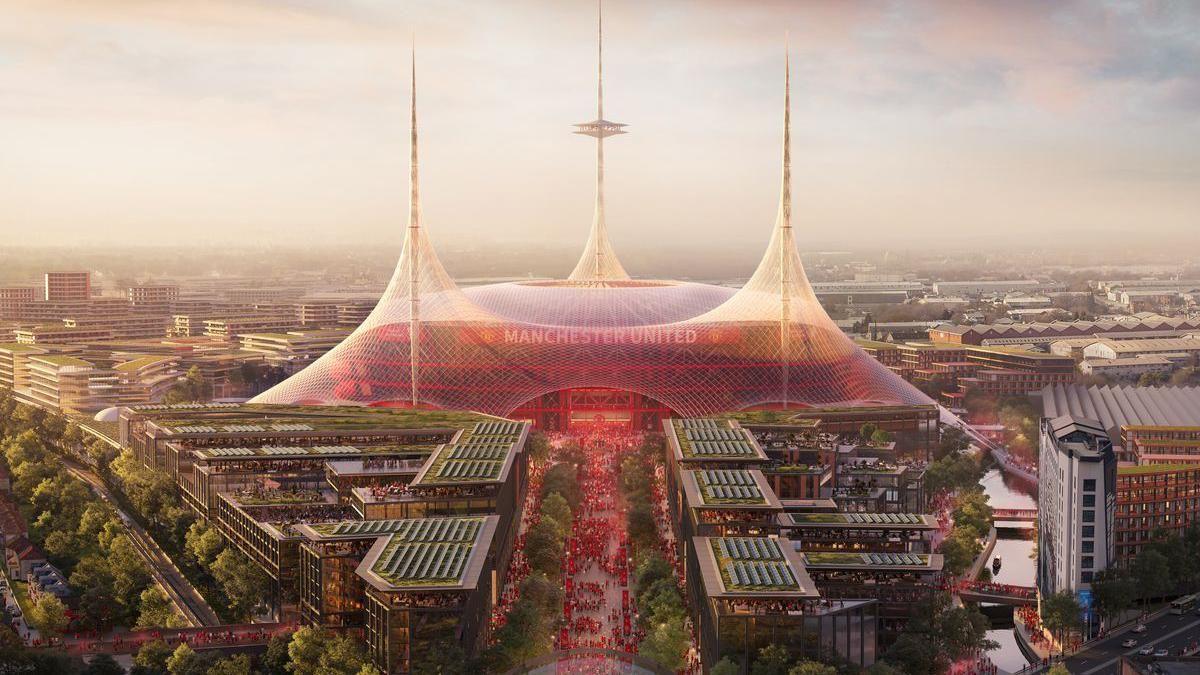
New Old Trafford included in 2035 World Cup bid
Manchester United’s proposed new Old Trafford stadium is included in the UK’s bid to host the 2035 Women’s World Cup.
Old Trafford was not considered for the 2028 men’s European Championship and its redevelopment is still in the planning stages.
England, Scotland, Wales and Northern Ireland’s joint bid stands unopposed and could be ratified by a vote in a Fifa congress in 2026.
If redevelopment plans do not go ahead, Old Trafford will still be considered in its current form.
In total the 21 other stadiums set to feature include Birmingham City’s planned new stadium and Wembley – which is likely to host the final.
Should the UK’s bid be confirmed, the 2035 tournament will be the second time a World Cup has been held in the home nations after the 1966 men’s tournament in England.
In total, 22 stadiums were listed in Friday’s announcement – 16 in England, three in Wales, two in Scotland and one in Northern Ireland.
———————————————————
2035 Women’s World Cup stadiums
-
Windsor Park (Belfast)
-
Sports Quarter Stadium (Birmingham)
-
Villa Park (Birmingham)
-
American Express Stadium (Brighton & Hove)
-
Ashton Gate (Bristol)
-
Cardiff City Stadium (Cardiff)
-
Principality Stadium (Cardiff)
-
Easter Road (Edinburgh)
-
Hampden Park (Glasgow)
-
Elland Road (Leeds)
-
Hill Dickinson Stadium (Liverpool)
-
Chelsea Stadium (London)
-
Emirates Stadium (London)
-
Selhurst Park (London)
-
Tottenham Hotspur Stadium (London)
-
Wembley Stadium (London)
-
Etihad Stadium (Manchester)
-
St James’ Park (Newcastle)
-
City Ground (Nottingham)
-
Stadium of Light (Sunderland)
-
Old Trafford (Trafford)
-
Stok Cae Ras (Wrexham)
———————————————————
From 2031, the Women’s World Cup will be contested between 48 teams – in line with the men’s format – and require 15 stadiums. The tournament would involve 104 matches contested by the 48 teams over 39 days.
A joint statement from the CEOs of The FA, Irish FA, Scottish FA and FA of Wales said: “A Women’s World Cup in the UK has the power to turbo charge the women’s and girls’ game both in the UK and globally.
“Our bid also demonstrates our commitment to leaving a lasting legacy, in the run up to 2035, and the years afterwards.”
Prime Minister Sir Keir Starmer said: “The Lionesses’ success has inspired girls across our country, and we’ll build on that momentum by welcoming millions of football fans from around the world to a tournament that will benefit communities and businesses in host cities up and down the UK.”
Scotland head coach Melissa Andreatta said: “The impact of bringing the World Cup to our nation would be felt for decades, driving participation, investment and equality at every level of the sport.”
England head coach Sarina Wiegman added: “It’s so much more than football, I think. It will boost the women’s game but it will boost women in society and, as we have seen, it will bring the country together.”

Wiegman on UK’s bid to host 2035 Women’s World Cup
Unbuilt stadiums included
The bid submission includes “Old Trafford in its current form” as proposals for a new 100,000-capacity stadium were not deemed sufficiently detailed for Fifa evaluation.
United announced plans for a revamped stadium in March and hope it will be completed in five years – although further progress has not yet been made.
Meanwhile, Birmingham City unveiled plans for their 62,000-seater Powerhouse Stadium in November, with a completion date set for the start of the 2030-2031 season.
Stok Cae Ras in Wrexham does not currently meet Fifa requirements, although there is planned redevelopment work which would make it eligible once completed.
Stamford Bridge also does not meet Fifa standards, so whether or not a Chelsea stadium can be considered for the tournament will depend on the outcome of a consultation on a new home which is under way.
The UK and Republic of Ireland’s joint bid to host Euro 2028 included Casement Park and Hill Dickinson Stadium, which were both unbuilt at the time of submission.
Casement Park will not be finished in time for the tournament, while Hill Dickinson Stadium has been selected as one of nine host grounds.
‘Long time before final decision made’ – analysis
Quite a few cities are going to be left disappointed. Fifa’s bid document for the Women’s World Cup requires a country to submit a minimum of 14 grounds, and there’s 22 on this list.
It is going to be a long time – probably at least five years – until a decision is made. That is why the likes of the Sports Quarter Stadium and Old Trafford, on which construction work is planned but not close to starting, have been included.
Fifa will hold on-site visits in February, before the publication of an evaluation report in March and a potential host vote on 30 April at the governing body’s congress. The UK bid is the only one on the table, so that would appear to be a formality, but the venues will not be set in stone at this point.
There is no specific deadline, and it is possible the list of stadiums could change over time. For instance, for the men’s World Cup next year Vancouver pulled out in 2021, and was then added back in as a candidate city in April 2022, and selected in the final announcement in June of that year.
For the Women’s World Cup, the final host cities have generally been announced much later – two years before the 2023 and 2027 events, compared to four years for the 2026 men’s finals.
But with so many more grounds needed (Brazil 2027 is only using eight) for an expanded 48-team tournament, you would think venue selection will come earlier.
The final decision will rest with Fifa but it is likely to be 2031 before we find out.