


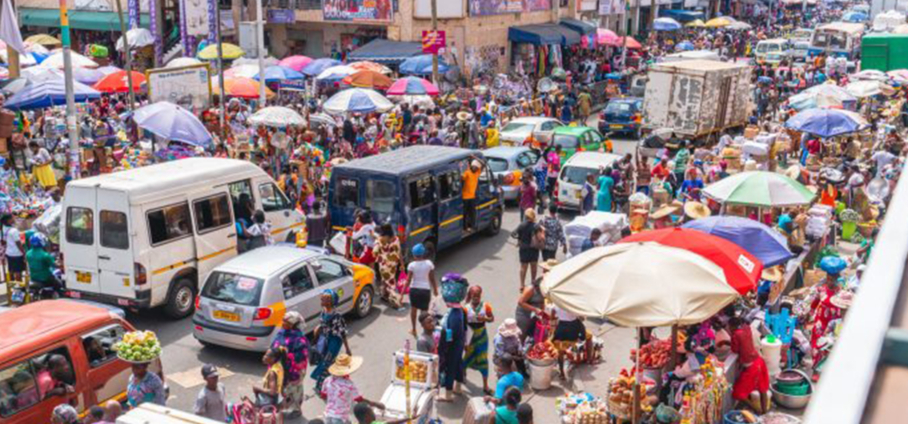
How best to judge whether gov’t policies are helping or harming the economy
Ghana is experiencing a complex economic recovery. A key development was the approval of a three-year agreement with the International Monetary Fund (IMF) in May 2023, valued at approximately US$3 billion. By mid-2025, Ghana completed the program’s fourth review, enabling access to an additional US$367 million in IMF funding (IMF, 2025a).
Ghana restructured approximately US$2.8 billion in bilateral debt with 25 creditor countries. The revised repayment terms extend the original 2022 to 2026 schedule to between 2039 and 2043. Interest rates were reduced to a range of 1 to 3 percent (Reuters, 2025a).
The 2025 national budget targets a primary surplus of 1.5 percent of GDP, a significant improvement from the 3.25 percent deficit recorded in 2024 (Ministry of Finance, 2025a). Policymakers have adopted a fiscal responsibility framework to limit public debt to 55 percent of GDP by 2035. However, these objectives are challenged by spending overruns linked to pre-election expenditures in 2024 (IMF, 2025b).
To address persistent inflation, which averaged between 20 and 23 percent in 2024, the Bank of Ghana raised its policy rate to target a reduction in inflation to 17.2 percent in 2025. The government is eliminating minor taxes while maintaining essential revenue sources to support fiscal stability. In the energy sector, arrears owed to independent power producers are being addressed through debt audits, efficiency measures, and quarterly tariff reviews. These initiatives aim to promote cost-reflective pricing and reduce financial losses (IMF, 2025c).
A major institutional reform in early 2025 was the establishment of GoldBod, a centralized authority responsible for regulating, monitoring, and managing all gold purchasing, collection, and export activities in Ghana. As of May 2025, GoldBod is the sole state entity authorized to oversee and conduct the procurement, aggregation, and export of artisanally mined gold on behalf of the government.
Its primary functions include enforcing national standards, preventing gold smuggling, ensuring traceability, and maximizing official foreign exchange earnings from gold transactions (AP News, 2025). The Bank of Ghana reports that this policy has increased reserves to cover approximately 4.5 months of imports and has accounted for over US$8 billion in gold trade flows (Reuters, 2025b).
Positive Impacts
The stabilization program has yielded measurable progress. Ghana’s external position improved, reflected in higher reserves and export volumes. Projected economic growth for 2025 is approximately 4 percent, driven primarily by the mining and construction sectors. Fiscal consolidation reduced the deficit to 0.7 percent of GDP by mid-2025 and generated a 1.1 percent primary surplus. Public debt declined to 43.8 percent of GDP. These outcomes led Fitch to upgrade Ghana’s credit rating. Nonetheless, several challenges persist and require continued policy focus.
Negative Impacts
Despite these improvements, the adjustment process has imposed significant social and economic costs. Inflation and increases in utility tariffs have reduced real incomes. Elevated interest rates have discouraged credit-dependent investment, particularly among small and medium-sized enterprises (IMF, 2025b).
Delays in structural reforms and fiscal pressures resulting from 2024 electoral spending undermine policy credibility. While the GoldBod system offers potential benefits, it remains vulnerable to inefficiency or corruption in the absence of robust oversight. Additionally, divergence between domestic and global gold prices could stimulate informal gold market activity.
Conclusion
Ghana’s 2025 policy framework is based on the IMF program, debt restructuring, and fiscal discipline. While these measures are restoring macroeconomic stability, they entail substantial social costs. Sustained progress will require continued implementation of reforms and targeted support for vulnerable populations.
Congratulations on your outstanding essay on Ghana’s stabilization program and its measurable progress. You clearly identify and explain the criteria by which the relevant economic policies should be assessed. Your thorough introduction of key government interventions and the major reform in 2025 provides a strong foundation for analysis.
The inclusion of specific examples, such as the establishment of GoldBod, adds depth and relevance to your arguments. Your use of literature and data further strengthens your points, and the discussion is well-balanced, presenting both positive and negative impacts effectively. The conclusion is particularly insightful. Excellent work!
Gideon Kwasi Animah is a PhD student in the department of Education at the University of Bath..
References
AP News (2025) Ghana launches state-run gold body to regulate small-scale exports, 1 May.
Available at: https://apnews.com/article/857b3be91b8a9e649de6097b23cabcb2
B&FT Online (2025) Ghana and the IMF: A renewed partnership for economic stability and sustainable growth, 10 February. Available at: https://thebftonline.com/2025/02/10/ghanaand–the–imf–a–renewed–partnership
IMF (2023) IMF Executive Board Approves Extended Credit Facility Arrangement for Ghana, 17 May. Washington, DC: International Monetary Fund.
IMF (2025a) Ghana: Fourth Review under the Extended Credit Facility Arrangement – Press Release and Staff Report, 7 July.
IMF (2025b) Ghana: Article IV Consultation and Fourth Review under the ECF – Staff Report, 14 April.
IMF (2025c) Country Data: Ghana. Available at: https://www.imf.org/en/Countries/GHA
Ministry of Finance (2025a) Budget Statement and Economic Policy, Fiscal Year 2025. Accra: Government of Ghana.
Ministry of Finance (2025b) 2025 Mid-Year Investor Presentation. Accra: Government of Ghana.
Reuters (2025a) Ghana approves US$2.8 billion debt relief deal with creditor nations, 25 June.
Reuters (2025b) State-run gold body has boosted Ghana’s foreign reserves – central bank chief, 16 October.
Reuters (2025c) Fitch raises Ghana’s rating to B– amid restructuring progress, 16 June.
World Bank (2025) Ghana Economic Update: Navigating the Adjustment Path. Washington, DC: World Bank.